How to Read a Circuit Breaker Panel: Labels and Breakers
Chameera Sampath · 10/18/2026
How to read a breaker panel: the main breaker, single, double and tandem breakers, GFCI and AFCI breakers, tripped positions, the directory and rating label.
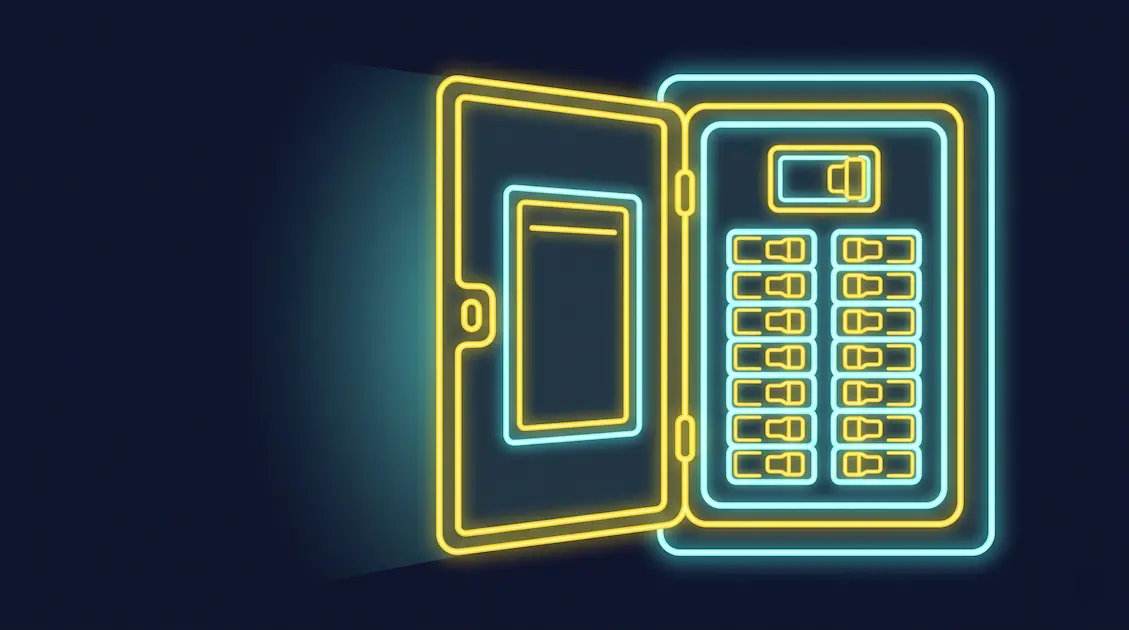
A circuit breaker panel, also called a breaker box, load center or panelboard, is the enclosure where a building's electrical service is divided into branch circuits, each protected by its own circuit breaker. Reading it means knowing what the main breaker, the branch breakers, the labels and the directory tell about the circuits they serve.
Quick answer. The large breaker at the top is the main, which shuts off the whole panel. Each smaller breaker protects one circuit; the number on its handle is its rating in amperes. Single breakers serve 120 V circuits, double breakers 240 V circuits. A tripped breaker sits in the middle position and is reset by pushing it fully off, then on. The directory on the door should say what every breaker controls.
Parts of a breaker panel
| Part | What it does |
|---|---|
| Main breaker | Disconnects the whole panel; its rating (commonly 100, 150 or 200 A) is the panel's service capacity |
| Bus bars | Metal bars behind the breakers that carry power from the main to each breaker |
| Branch breakers | One per circuit; trip on overload or short circuit |
| Neutral bar | Terminal bar where the white neutral conductors land |
| Ground bar | Terminal bar for the bare or green grounding conductors |
| Dead front | The inner cover with cut-outs for the breaker handles; it shields the live parts |
| Panel directory | The label on the door listing what each breaker serves |
| Rating label | Inside the door; states voltage, bus rating, maximum breaker sizes and compatible breaker types |
Reading the breakers
Rating. The number on the handle, such as 15, 20, 30 or 50, is the breaker's current rating in amperes. It is matched to the size of the wire on that circuit; 15 A breakers normally protect 14 AWG copper and 20 A breakers 12 AWG copper.
Single-pole breakers occupy one space and serve 120 V circuits: lighting, general receptacles, small appliances.
Double-pole breakers occupy two spaces with a handle tie and serve 240 V circuits: ranges, dryers, water heaters, air conditioners, EV chargers. Both halves trip together.
Tandem breakers fit two single-pole circuits in one space. They may be used only where the panel's label allows them and only in the positions it specifies.
GFCI and AFCI breakers have a test button and usually a white coiled wire, called a pigtail, connected to the neutral bar. GFCI breakers protect people from shock; AFCI breakers protect against fires caused by arcing. Dual-function breakers combine both.
Reading the breaker positions
| Handle position | Meaning |
|---|---|
| Fully on | Circuit energized |
| Fully off | Circuit switched off |
| Middle, or not aligned with its neighbors | Tripped |
A tripped breaker is reset by pushing the handle firmly to off, then back to on. If it trips again immediately, the circuit has a fault and should not be reset repeatedly; see what to do when a breaker keeps tripping.
Reading the panel directory
The National Electrical Code requires every circuit in a panel to be legibly identified by its purpose, specific enough to tell it apart from every other circuit. "Kitchen counter, left of sink" meets that standard; "plugs" does not. Many older panels have missing or out-of-date directories.
A directory can be rebuilt by switching circuits off one at a time and noting what loses power. Recording the breaker number, rating, poles and the rooms or equipment served produces a panel schedule, the same document electricians prepare for new installations; the panel schedule template lays one out by space number and prints it for the panel door.
What the rating label shows
The label inside the door is the panel's specification. It gives the voltage (usually 120/240 V for houses), the bus rating, which is the maximum current the panel itself can carry, the main breaker rating, the breaker types listed for use in it, and where tandem breakers are permitted. Breakers from other manufacturers that are not listed for the panel should not be installed in it, even if they appear to fit.
Main breaker size and service capacity
The main breaker rating is the most current the panel can supply to the whole house at once. Older houses often have 60 A or 100 A services; newer houses commonly have 200 A. Whether a service is adequate is determined by a load calculation, which totals the house's lighting, appliances, heating and cooling using demand factors; see the residential load calculation guide.
Testing GFCI and AFCI breakers
Manufacturers recommend pressing the test button on GFCI and AFCI breakers regularly, typically monthly. The breaker should trip; it is then reset by moving the handle to off and back on. A device that does not trip when tested should be replaced.
Safety
The door and directory may be used by anyone. The dead front, the inner cover, should not be removed except by a qualified person: the bus bars and the service conductors above the main breaker remain energized even with the main switched off.
Frequently asked questions
How do I know which breaker controls which outlet? From the panel directory, if it is accurate. Otherwise, by switching breakers off one at a time with a lamp or tester plugged into the outlet.
What does the number on a breaker mean? Its rating in amperes, the current above which it will trip. The rating is chosen to protect the wire on that circuit; the breaker size calculator shows how ratings are selected.
What is the difference between a single and a double breaker? A single-pole breaker serves a 120 V circuit; a double-pole breaker occupies two spaces and serves a 240 V circuit.
Why is one breaker in the middle position? It has tripped. Pushing it fully off and then on resets it.
Does turning off the main breaker make the panel safe to open? No. The conductors feeding the main breaker remain live. Work inside the panel should be left to a licensed electrician.
Scope
This guide describes residential panels in the United States, where requirements follow the National Electrical Code. Panel work beyond resetting breakers and updating the directory should be carried out by a licensed electrician.
Written by Chameera Sampath. Not yet reviewed by a licensed electrician — see the methodology page. To report an error, use the contact page.