What Is a Short Circuit? Causes, Signs and Protection
Chameera Sampath · 10/17/2026
What a short circuit is, why current rises so sharply, how it differs from a ground fault, overload and arc fault, why a breaker trips and what to do next.

A short circuit is an unintended, low-resistance connection between two conductors at different voltages, such as a hot conductor touching a neutral or another hot conductor. Because almost nothing limits the current through that path, it rises in a fraction of a second to many times the normal load current, and the circuit breaker or fuse is expected to open before the heat damages wiring or starts a fire.
Quick answer. In a short circuit, current bypasses the load and flows through a path with very little resistance. By Ohm's law (I = V ÷ R), very low resistance means very high current. A breaker trips instantly on a short circuit; a breaker that trips only after running for a while is more likely overloaded.
How a short circuit happens
In a normal circuit, current flows from the source along the hot conductor, through a load such as a lamp or a motor, and back along the neutral. The load's resistance limits the current to a safe value.
In a short circuit the current finds a shortcut around the load. Insulation wears through, a loose wire touches a terminal it should not, or a screw pierces a cable, and the hot and neutral, or two hots, connect directly. The only resistance left is that of the wires themselves and the supply, which is a tiny fraction of an ohm.
The effect follows from Ohm's law. A 120 V circuit feeding a 12 Ω heater draws 120 ÷ 12 = 10 A. If the same circuit is shorted through a path of 0.05 Ω, the current would be 120 ÷ 0.05 = 2,400 A if nothing else limited it. In practice the impedance of the transformer and the wiring back to it limits the current, but it remains hundreds or thousands of amperes. The Ohm's law calculator shows how sharply current rises as resistance falls.
Short circuit, ground fault, overload and arc fault
Four faults are often confused. They differ in where the current goes and how fast it rises.
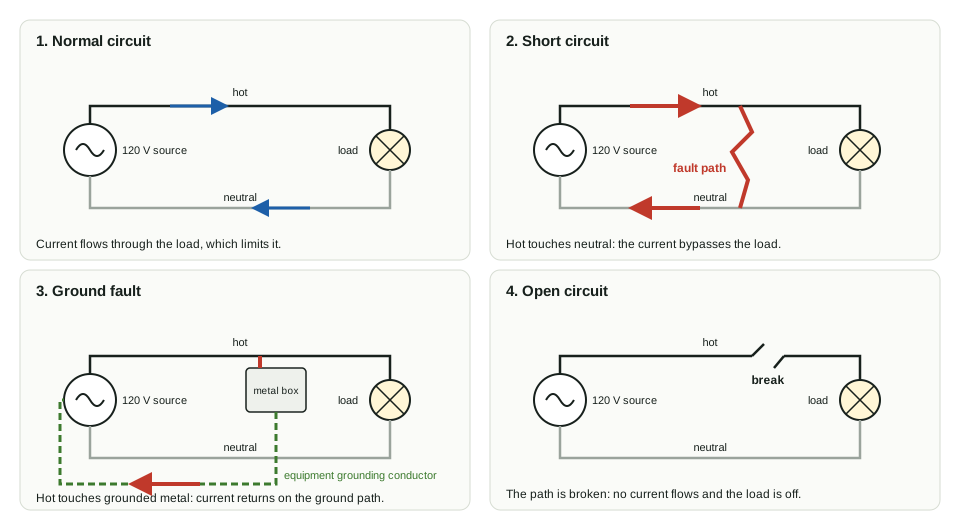
Normal circuit, short circuit, ground fault and open circuit. In the first three current flows; only in the normal circuit is it limited by the load.
| Fault | What happens | Typical current | Protection |
|---|---|---|---|
| Short circuit | Hot touches neutral or another hot | Very high, instantly | Breaker or fuse (instantaneous trip) |
| Ground fault | Hot touches ground, a grounded metal box, or a person | Anywhere from a few milliamperes to very high | GFCI for people; breaker or fuse for equipment |
| Overload | Too many loads on a circuit, current through the normal path | Moderately above rating | Breaker or fuse (time-delay trip) |
| Arc fault | Current jumps a gap at a loose or damaged connection | May be below breaker rating | AFCI |
A ground fault is a form of short circuit to ground. When it flows through a person, a few milliamperes can be dangerous, far below anything a standard breaker detects; that is why GFCI protection, which trips at about 5 mA, exists. An arc fault may draw no more than normal current yet reach temperatures that ignite nearby material, which is the hazard AFCI protection addresses.
What happens inside the breaker
A standard thermal-magnetic circuit breaker has two trip mechanisms:
- Thermal: a bimetal strip heats and bends under sustained overcurrent and trips the breaker after a delay. The larger the overload, the shorter the delay.
- Magnetic: a coil trips the breaker within a cycle or two when current jumps to many times the rating, as in a short circuit.
A fuse works similarly: its element melts quickly under the very high current of a short circuit. In both cases the device must be able to interrupt the highest current the supply can deliver at that point. That figure is the available fault current, and every breaker and fuse carries an interrupting rating that must equal or exceed it. The transformer sizing guide shows how a transformer's impedance sets the available fault current on its secondary.
Available fault current at the service
The available fault current is the largest current that would flow if the conductors at a point were connected together with no resistance at the fault itself, a so-called bolted fault. It is highest at the service and falls with every foot of conductor between the source and the fault, because each length of wire adds impedance.
At the service it depends mainly on the utility transformer: its kVA rating, its impedance (%Z, printed on the nameplate) and the length and size of the conductors from the transformer to the house. A first estimate treats the utility supply as unlimited and uses the transformer alone:
- Full-load current: I = kVA × 1,000 ÷ V. For a 50 kVA, 120/240 V transformer, 50,000 ÷ 240 = 208 A.
- Fault current at the transformer terminals: I(fault) = full-load current × 100 ÷ %Z. With an example impedance of 2.0%, 208 × 100 ÷ 2.0 ≈ 10,400 A.
The service conductors then reduce that figure at the meter and panel; the point-to-point method carries the calculation along each conductor, and the available fault current calculator works through it. Utilities provide the available fault current at a service on request, and their figure takes precedence over an estimate.
The number matters because a breaker or fuse must be able to interrupt it. NEC 110.9 requires every interrupting device to have an interrupting rating at least equal to the current available at its line terminals, and NEC 110.10 requires the equipment's short-circuit current rating to suit the circuit. Many residential breakers carry a 10,000 A interrupting rating, and higher-rated breakers are available for services close to large transformers. For service equipment in other than dwelling units, NEC 110.24(A) also requires the maximum available fault current to be marked in the field. A fault current estimate is not a coordination study or an arc-flash assessment.
Common causes
- Insulation damaged by age, heat, rodents or abrasion against a sharp edge
- Loose terminal screws that let a conductor shift onto another terminal
- Nails or screws driven through cables in walls
- Water entering boxes, fixtures or outdoor connections
- Faulty appliances, cords and plugs
- Conductors pinched behind a device or cover when a box is too full; the box fill calculator checks whether a box has enough volume
Signs of a short circuit
- A breaker trips immediately when it is reset or when a particular appliance is switched on
- A fuse blows instantly, often with a blackened window
- Scorch marks, melted insulation or a burning smell at a receptacle, switch or appliance
- A spark or pop when something is plugged in
What to do
- Switch off and unplug whatever was in use when the breaker tripped.
- Reset the breaker once. If it holds, plug devices back in one at a time; the one that trips it is the likely fault.
- If the breaker trips again with everything unplugged, the short is in the fixed wiring. Leave the breaker off and have the circuit traced by a licensed electrician.
- Never replace a breaker or fuse with a larger one to stop tripping. The rating protects the wire; the breaker size calculator and fuse size calculator explain how ratings are chosen.
Short circuit and open circuit
The two are opposites. A short circuit has too little resistance and too much current. An open circuit has a break in the path, so no current flows at all, as when a wire comes loose or a switch is off.
Frequently asked questions
What is a short circuit in simple terms? A path that lets electricity bypass the device it is meant to power and flow straight back to the source, with almost nothing to limit the current.
Is a short circuit dangerous? Yes. The current can heat conductors enough to melt insulation and ignite surrounding material in seconds, and the arc at the point of contact can cause burns. Circuit breakers and fuses exist to interrupt it quickly.
Can a short circuit fix itself? Sometimes the fault burns itself open and the breaker then holds, but the damage that caused it remains and usually returns. A circuit that has shorted should be inspected.
Why does my breaker trip instantly when I turn on one appliance? The appliance or its cord most likely has an internal short or ground fault. Unplugging it and confirming that the breaker then holds identifies the cause.
What is the difference between a short circuit and a ground fault? In a short circuit the hot conductor touches the neutral or another hot conductor. In a ground fault it touches the equipment grounding conductor, a grounded metal box or a person, and the current returns through the grounding path or the earth. A ground fault through a low-impedance grounding path behaves like a short circuit and trips the breaker; one through a person may be far too small for a breaker to detect, which is what GFCI protection is for.
Can a GFCI stop a short circuit? Not by its ground-fault function. A GFCI compares the current on the hot and neutral; a hot-to-neutral short keeps them equal, so the GFCI does not see it as a ground fault. The circuit breaker or fuse clears the short circuit.
What is available fault current? The largest current a bolted short circuit could draw at a given point, set by the utility transformer's rating and impedance and by the conductors between the transformer and the fault. Breakers and fuses must have an interrupting rating at least equal to it, under NEC 110.9.
What is an open circuit? A circuit with a break in its path, such as a loose connection, a broken conductor or a switch in the off position. No current flows, so the load does not operate.
What is the difference between a short circuit and an overload? A short circuit is a fault path with very low resistance and very high current, tripping the breaker instantly. An overload is too much normal load, with current moderately above the rating, tripping the breaker after a delay.
Scope
This article describes 120/240 V residential and light commercial circuits in the United States, with protection practice following the National Electrical Code. Fault investigation and repair in fixed wiring should be carried out by a licensed electrician.
Written by Chameera Sampath. Not yet reviewed by a licensed electrician — see the methodology page. To report an error, use the contact page.